
Written by Thea Rillera and Mae Janica Palkit
As a contributing pillar to the local and global community, the University of Baguio always aims to build a more sustainable society through its different academic, extracurricular, and outreach programs. To better aid in this objective, one of the university’s key focus areas is the development of its programs under Sustainable Development Goal (SDG) 17: Partnerships for the goals. By connecting with external partners from the different sectors of the community, the university is able not only to accrue more resources but also to broaden its reach and allow for a wider scope of impact.
For the Academic Year 2025-2026, UB has a total of 122 new and renewed partners across five different sectors:
- 24 in the Government Sector (CFO, DILG, DICT CAR, OCD-CAR, PhilHealth, DSWD, various LGUs and Municipal Tourism Offices)
- 12 in the Academe Sector (Huachiew Chalermprakiet University, California Metropolitan University, University of Puthisastra, Mountain Province State University, local Elementary/High Schools)
- 5 with NGOs/Foundations (Megawide Corporation Foundation, Vivita Philippines Charities, Rotary Club, Junior Chamber International, Helping Hands Healing Hearts Ministries)
- 75 in the Private Industry Sector (banks, multiple hotels, restaurants, travel and tour agencies, IT solution companies, semiconductor companies, construction services, and publishing houses)
- 6 with International Institutions (Grand Hyatt Hong Kong, Hyatt Regency Tsim Sha Tsui, Hyatt Regency Sha Tin, Centara Hotels & Resorts, Hangzhou Medical College, University of Puthisastra)
These partnerships are not only in service of SDG 17, but SDGs 1 through 16.
Partnerships within the government sector directly address SDGs 3 (Good Health and Well-Being), 11 (Sustainable Cities and Communities), and 16 (Peace, Justice, and Strong Institutions), maintaining direct collaborative ties with government units to enhance public services, create safe and resilient digital and physical spaces, and improve and nurture programs that uphold justice, rehabilitation, and social protection. The School of Law, School of Information Technology, School of Criminal Justice and Public Safety, Allied Medical Schools (Nursing, Natural Sciences, Dentistry), and the UB High School are all key parts of the university that target these areas.
Partnerships in the academe sector focus keenly on supporting SDG 4 (Quality Education) by facilitating the cross-institutional benchmarking to ensure that the local community’s educational services remain balanced and on par with global standards. It also provides opportunities for international educational training, student mobility, and cultural exchange. All schools participate in upholding this SDG, though there are expressly more concentrated efforts on behalf of the School of Teacher Education and Liberal Arts, UB High School, and UB Laboratory Elementary School.
Partnerships with NGOs and other civic organizations support SDG 1 (No Poverty), 3 (Good Health and Well-Being), and 11 (Sustainable Cities and Communities) by targeting immediate social inequities, such as in healthcare and medical support, and through local economic empowerment initiatives.
Partnerships in the Private Industry Sector mainly focus on supporting SDGs 8 (Decent Work and Economic Growth) and 9 (Industry, Innovation, and Infrastructure) by nurturing innovation within major production industries in order to pioneer real-world solutions for infrastructural concerns in the fields of hospitality, information technology, engineering and architecture, and finance. The School of International Hospitality and Tourism Management, the School of Information Technology, the School of Engineering and Architecture, and the Campus Planning and Development Office all contribute to these efforts through their collaborative initiatives and programs.
Apart from academic endeavors and community outreach, UB’s partnerships also foster knowledge exchange, capacity-building, and research collaboration, bridging the academe and society and nurturing long-term development outcomes that can face contemporary real-world challenges head-on.
UB’s role in a Sustainable Society
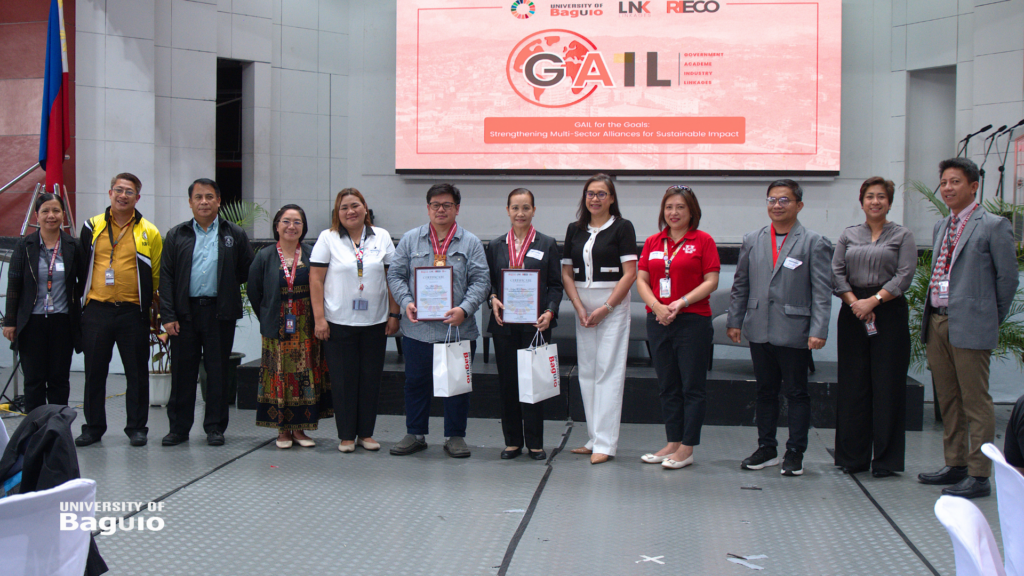
Beyond just academic collaborations that improve UB’s quality of education, these partnerships are also integral in fostering resilient and empowered communities. By coordinating with stakeholders from various sectors and coordinating joint efforts to directly address community needs, the university and its partner organizations create a nurturing space for innovation, promote volunteerism, and uphold social responsibility. The numerous programs and initiatives enacted through these partnerships serve to enhance the university’s institutional growth while also strengthening its role as a catalyst for inclusive progress towards a more sustainable society.
As the University of Baguio continues to move forward towards a sustainable future, SDG 17 lies at the heart of its efforts, connecting the community from the individual to the organization and uniting them towards a shared goal. Through strengthened alliances and collective action, the university continues to push and uphold the belief that a sustainable society is only achievable through the collective efforts of a community.